
Exness Leverage Explained: How It Sets Your Margin, and Why It Doesn't Change Your Risk
Exness leverage sets how much margin you lock up per trade, not how much you can lose. See the margin arithmetic and how to check your own cap.
- Written by Blocktechpro Editorial Team
- Edited by Blocktechpro Editorial Team
- Fact-checked against verified broker disclosures,
Exness leverage is the ratio between the size of a position and the margin you must put up to open it. A 1:100 ratio means a position worth $110,000 needs $1,100 of margin. Leverage changes how much of your balance is tied up, but your profit or loss is set by lot size and how far price moves. The exact maximum you can choose depends on your account, region and Exness entity, so confirm it on the official Exness site and in your account settings.
What leverage means in plain numbers
Leverage is a borrowing-like facility from the broker that lets you control a larger notional position than your deposit. The formula is simple:
- Notional value = lots x contract size x price
- Required margin = notional value / leverage ratio
A standard forex lot is 100,000 units of the base currency. For XAU/USD, one lot is 100 oz.
Worked example 1: margin for 1 lot of EUR/USD
Example only. The 1.1000 price is hypothetical, for illustration, and the leverage ratios are illustrative, not Exness limits.
- Notional: 1 lot x 100,000 x 1.1000 = $110,000
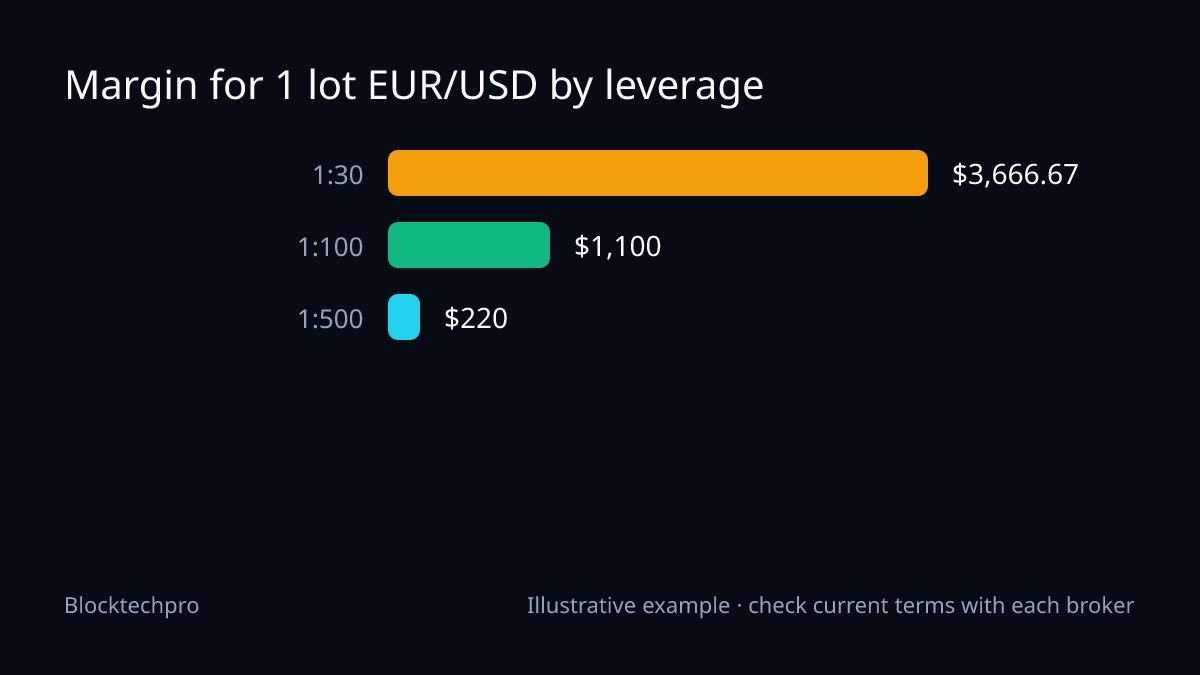
- At 1:30: $110,000 / 30 = $3,666.67 margin
- At 1:100: $110,000 / 100 = $1,100 margin
- At 1:500: $110,000 / 500 = $220 margin
You can test your own numbers with our Margin Calculator.
Worked example 2: gold (XAU/USD)
Example only, at a hypothetical price of 2,400.00. One lot is 100 oz, so notional is 100 x $2,400 = $240,000. At 1:100, margin is $240,000 / 100 = $2,400. At 0.10 lots (10 oz), notional is $24,000 and margin is $240. A $0.10 move is $10 per lot, though some brokers count $0.01 as a pip, so check the contract specification.
Why higher leverage does not change your loss per pip
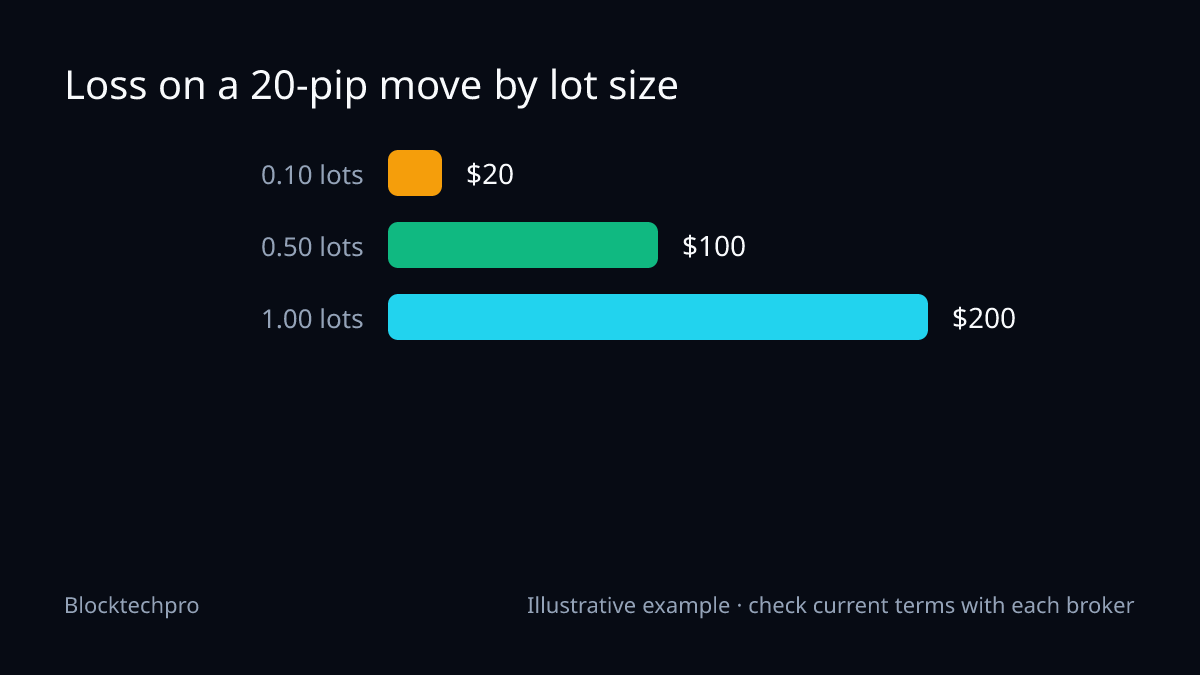
Pip value on EUR/USD is $10 per pip per standard lot. A 20-pip move against you costs lots x $10 x 20, whatever the leverage ratio.
- 0.10 lots: 0.10 x $10 x 20 = $20
- 0.50 lots: 0.50 x $10 x 20 = $100
- 1.00 lots: 1.00 x $10 x 20 = $200
What higher leverage changes is how large a position your balance will let you open. That is where the danger lies.
Worked example 3: a $1,000 balance
Example only, hypothetical 1.1000 price. You open 0.50 lots of EUR/USD, a notional of $55,000.
- At 1:100: margin = $55,000 / 100 = $550, leaving $450 free
- At 1:500: margin = $55,000 / 500 = $110, leaving $890 free
A 20-pip adverse move costs $100 in both cases. The free margin looks more comfortable at 1:500, but the loss is the same. Over-sizing positions because margin is cheap is how accounts get stopped out. Size from your risk instead: our Lot Size Calculator works backward from a stop distance and a risk percentage.
How to find your own Exness leverage
Do not rely on a number you read in a forum, because caps differ by account type, region and regulated entity. Exness operates through several entities, and some, such as the FCA (UK) and CySEC (Cyprus) entities, accept professional clients only (Exness website footer). To confirm yours:
- Check the leverage and account pages on the official Exness website for your region.
- Open the contract specification for each instrument in MT4, MT5 or the Exness terminal.
- Check the leverage shown for your trading account in your personal area.
- If anything is unclear, ask Exness support, and ask whether the cap changes with balance, instrument or market conditions.
Availability also matters. The global Exness site does not serve residents of the USA, Canada, Europe, the UK, Russia and Belarus, among other jurisdictions (Exness Standard accounts page).
Leverage and trading costs are separate
Leverage does not change spreads or commissions. Those depend on the account type. Exness Standard offers spreads from 0.2 pips with no commission (Exness Standard accounts page). Raw Spread offers spreads from 0.0 pips with commission up to $3.50 each side per lot, which is up to $7.00 round turn (Exness Professional accounts page). Our Exness account types comparison covers the differences.
Example only, with a hypothetical 0.5-pip spread: for 0.50 lots on Raw Spread, spread cost = 0.5 pips x $10 x 0.50 = $2.50, and commission = up to $7.00 x 0.50 = $3.50. The total is up to $6.00 before any rebate, at 1:30 or 1:500 alike. Swaps also apply if you hold overnight. They vary by instrument, direction and broker and appear in the platform's contract specification.
Where rebates fit
The Exness partner program pays up to 40% of Exness revenue from your trades, as published by the broker. Blocktechpro passes a share of that back, and the exact share is confirmed at sign-up. It is never the full partner rate. When registering, the partner code field comes after email and password (Exness Help Center: Registering an Exness account). Our code is ccm34k1you. You can open an Exness account through our partner link, and the Exness rebate guide explains how the money flows. A rebate lowers your cost per lot. It does not change your leverage or your risk.
Practical rules for using leverage
- Pick lot size from your stop distance and risk percentage, not from the maximum the margin allows.
- Keep plenty of free margin so normal price swings cannot trigger a stop out.
- Check margin before holding positions over news events or weekends.
- Confirm margin call and stop out levels on Exness's official pages. Do not assume them.
Risk warning
Leveraged forex and CFD trading can lose money quickly, and you can lose more than you expected if positions are oversized. Rebates do not offset trading losses. Broker terms, including leverage, vary by country and change over time, so confirm them on the broker's website. Read our risk disclaimer before you trade.
Topics
- Exness leverage
- margin
- risk management
- lot size
Related guides
All guides →
IC Markets Review: Raw Spread vs Standard, cTrader, Entities and Rebates
An IC Markets review from published terms: $0 minimum deposit, Raw Spread $3.50 per side vs Standard from 0.8 pips, cTrader, regulators by entity and rebates.
Markets4you Review: Standard vs Pro Costs, Offshore Regulation and Partner Tiers
A sourced Markets4you (Forex4you) review: Standard from 0.9 pips vs Pro $3.50 per side, BVI and Mauritius FSC licences, leverage, and its published partner tiers.
Vantage Review: Standard STP vs Raw ECN Costs, Licences and Rebates
A sourced Vantage Markets review: Standard STP vs Raw ECN cost per lot, $50 minimum deposit, ASIC/FCA and offshore entities, platforms and partner terms.