Exness Rebates Explained: How to Get Cashback on Every Lot You Trade
How Exness rebates (cashback) work, what you can realistically get back per lot, how to set them up on a new or existing account, and the mistakes to avoid.

An Exness rebate is cash paid back to you for every lot you trade, funded by part of the spread or commission Exness already earns from your account. It does not change your trading conditions, and it is paid whether a trade wins or loses. This guide explains where the money comes from, how much is realistic, and how to set it up.
What is an Exness rebate?
Exness, like most brokers, runs a partner program for introducing brokers (IBs): websites, educators and communities that refer clients. For every client they refer, Exness pays the partner a share of the revenue it makes from that client's trading — mostly the spread, plus commission on Raw Spread and Zero accounts.
A rebate (also called cashback or "backcom") partner passes part of that share back to you. Exness pays partners up to 40% of the revenue it generates from your account (per the Exness partner program), and Blocktechpro passes a share of that back to you. At the full 40% rate that works out at roughly $3–$16 per standard lot, depending on the instrument and account type.
Three things are worth knowing up front:
- It is not a bonus. There are no trading-volume conditions to unlock it and it is not credit that disappears on withdrawal. It is cash.
- It does not raise your costs. Your spread and commission are the same whether or not you are linked to a partner.
- It does not depend on results. A losing trade earns the same rebate as a winning one, because the broker earned its spread either way.
How much can you get back?
The simplest way to estimate it is monthly rebate = lots traded per month × rebate per lot. The rebate per lot varies: instruments with wider spreads, such as gold and some minor pairs, generate more revenue per lot than tight major pairs.
| Monthly volume | At $3 / lot | At $8.50 / lot | At $16 / lot |
|---|---|---|---|
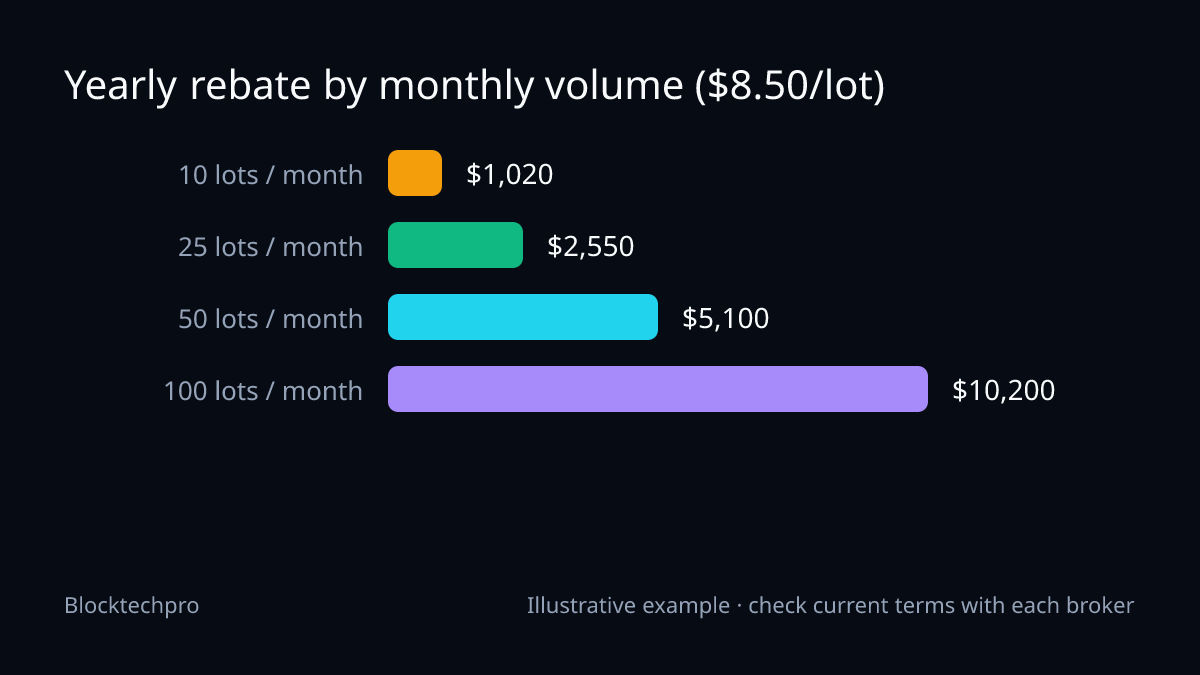
| 10 lots | $30 | $85 | $160 |
| 25 lots | $75 | $212.50 | $400 |
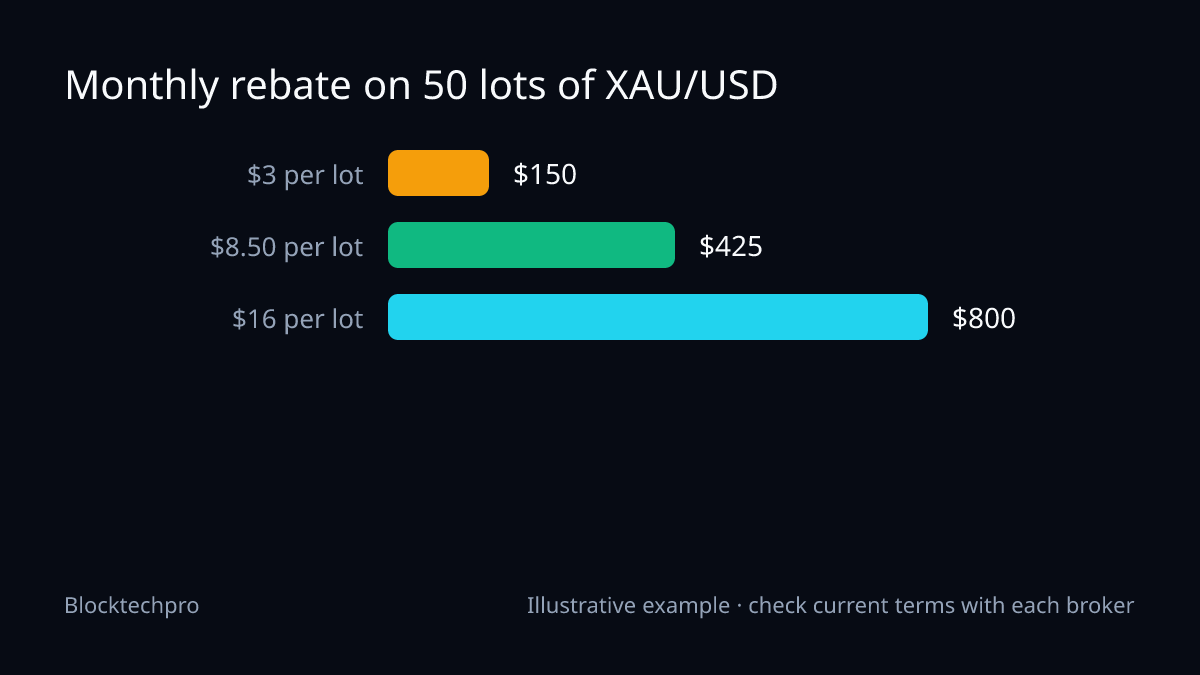
| 50 lots | $150 | $425 | $800 |
| 100 lots | $300 | $850 | $1,600 |
For example, a trader who places 50 standard lots of XAU/USD a month at an average of $8.50 per lot would receive about $425 a month.
Over a year the numbers add up, which is why rebates matter most to active traders. They matter much less if you trade a few micro lots a month.
You can plug in your own volume with the rebate calculator on our home page.
How to set it up
If you are opening a new Exness account
- Register through our Exness link so the account is linked to us as your partner.
- Complete Exness's identity verification so you can deposit and withdraw without limits.
- Trade as you normally would. Rebates are calculated from closed volume and paid daily.
If you already have an Exness account
Exness can move an existing client to a different partner, but it is a request to Exness support, not an automatic switch. Open a live chat or email support from your Personal Area, ask for a partner change to Blocktechpro (email us for our partner details), and be ready to explain why. Approval is at Exness's discretion and depends on factors such as your current partner link and account history. If the request is declined, the alternative is to open a new account under the partner code.
Still choosing a broker? See how Exness and XM rebates compare.
Mistakes to avoid
- Overtrading to earn more rebate. A rebate of $8.50 per lot is small next to a typical stop-loss on gold. If a 0.50-lot position is stopped out $10 away, you lose $500 and earn about $4.25 back. Rebates reduce costs; they never turn a losing strategy into a winning one.
- Picking an account type for the rebate alone. Raw Spread and Zero accounts charge a commission and have tighter spreads; Standard accounts build the cost into the spread. Compare the total cost per lot (spread + commission − rebate), not the rebate on its own.
- Ignoring position size. Rebates are paid per lot, so they tempt traders to size up. Size every trade from your risk instead — our guide to calculating gold lot size with the 1% rule shows how.
- Assuming every product is available. Exness operates through different entities in different regions, and leverage, swap-free conditions and payment methods vary. Check what applies in your country.
Key takeaways
- A rebate returns part of the spread or commission you already pay; it does not change your trading conditions.
- Expect roughly $3–$16 per standard lot, depending on the instrument and account type.
- New accounts can be linked at sign-up; existing accounts need a partner-change request that Exness may or may not approve.
- Trading carries a high risk of loss. Rebates lower costs but do not reduce market risk.
Topics
- Exness rebate
- forex cashback
- XAU/USD
- introducing broker
- trading costs
Related guides
All guides →
Bybit Futures Fee Rebates: How Much Active Traders Can Save
Bybit charges 0.055% taker and 0.02% maker on futures. See what that costs at different volumes, how a 30–50% fee rebate works, and other ways to cut fees.
How to Calculate Lot Size for Gold (XAU/USD) with the 1% Risk Rule
Step-by-step formula for gold position size: 1 lot is 100 oz, so a $1 move is worth $100 per lot. Worked examples for $1,000–$10,000 accounts and common mistakes.
Exness vs XM Rebates: Which Broker Pays More Back Per Lot?
Exness and XM rebates side by side: how each is calculated, typical amounts per lot, payout frequency and account types, plus which suits your trading style.