Bybit Futures Fee Rebates: How Much Active Traders Can Save
Bybit charges 0.055% taker and 0.02% maker on futures. See what that costs at different volumes, how a 30–50% fee rebate works, and other ways to cut fees.

On Bybit futures, fees are charged on the full position value, not on your margin. That makes them easy to underestimate. This guide shows what Bybit's fees cost at realistic volumes, how a fee rebate of 30–50% works, and the other levers that reduce costs.
How Bybit futures fees are calculated
At the standard (non-VIP) tier, Bybit charges 0.055% for taker orders (orders that fill immediately, such as market orders) and 0.02% for maker orders (limit orders that add liquidity to the order book). VIP tiers are cheaper, and rates can change, so check Bybit's fee page for the current schedule.
The fee applies to the notional value — position size × price — on both the opening and the closing trade. A worked example:
- Margin: $1,000 at 20× leverage gives a $20,000 position.
- Taker fee to open: $20,000 × 0.055% = $11.
- Taker fee to close: about $11 again.
- Round-trip cost: about $22, or 2.2% of the margin you put up.
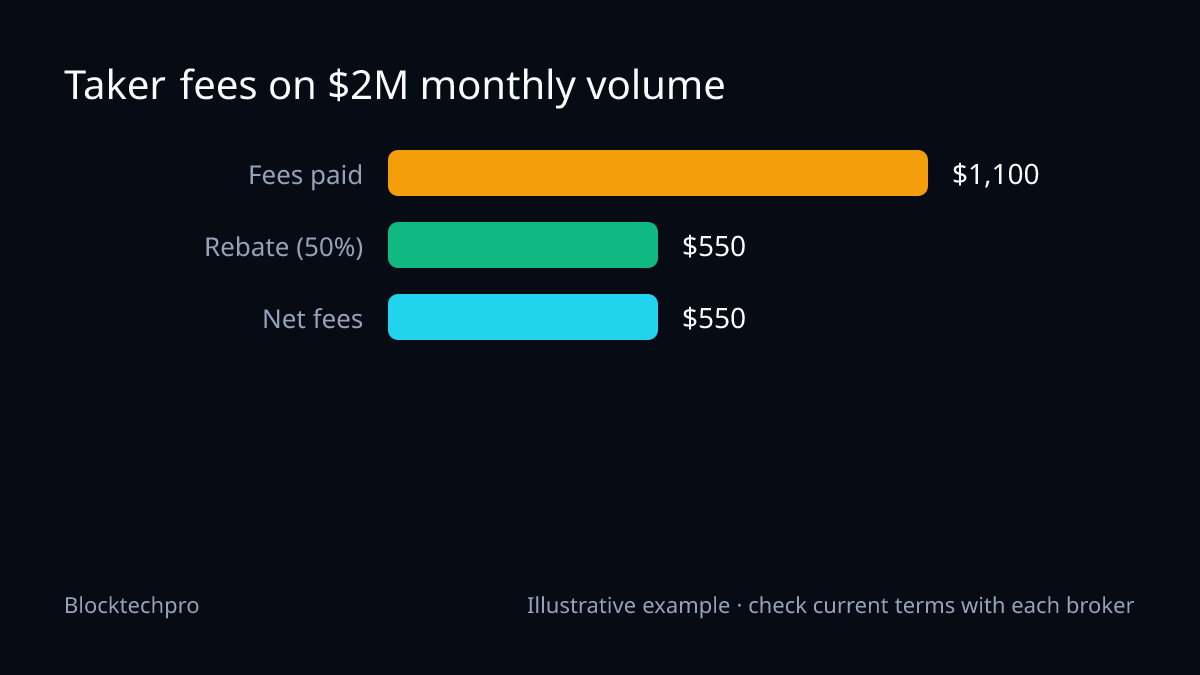
Do that 50 times a month and your notional volume is $2,000,000 and your fees are about $1,100. For a scalper, fees can easily exceed the strategy's gross profit.
How a fee rebate works
Bybit pays affiliates up to 50% of the trading fees generated by users they refer, with the rate rising with referral volume (per the Bybit affiliate program). A rebate partner such as Blocktechpro passes part of that share back to you. The tables below use 50% to show the maximum; your confirmed share may be lower.
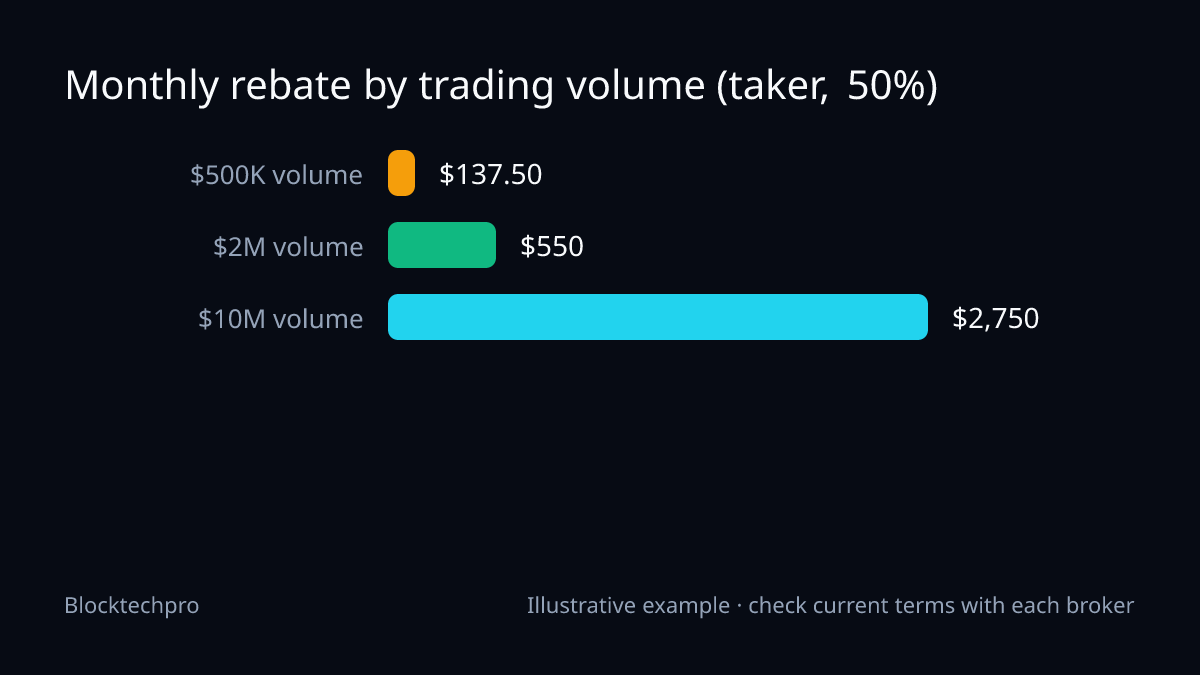
| Monthly volume (notional) | Taker fees at 0.055% | Rebate at 50% | Net fees |
|---|---|---|---|
| $500,000 | $275 | $137.50 | $137.50 |
| $2,000,000 | $1,100 | $550 | $550 |
| $10,000,000 | $5,500 | $2,750 | $2,750 |
Because volume scales with both leverage and trade frequency, the rebate grows quickly for active traders:
Use maker orders where you can
The rebate is not the only lever. Switching from market orders to limit orders cuts the base fee by almost two thirds:
| Order mix on $2M volume | Fees | After 50% rebate |
|---|---|---|
| 100% taker (0.055%) | $1,100 | $550 |
| 50% maker / 50% taker | $750 | $375 |
| 100% maker (0.02%) | $400 | $200 |
Limit orders are not free: they may not fill, and chasing a missed entry with a market order costs more than taking it in the first place. Use post-only limit orders for planned entries and keep market orders for exits that must happen now, such as a stop-loss.
What about VIP tiers?
Bybit lowers maker and taker rates as your 30-day trading volume or asset balance reaches its VIP thresholds. A rebate is calculated on the fees you actually pay, so as your tier improves, both your fees and your rebate per trade fall. For most retail traders the standard tier applies, and the rebate is the bigger saving. Compare your current tier on Bybit's fee page before you estimate savings.
Checking that rebates arrive
After your first full week of trading, compare the fees shown in your Bybit trade history with the rebates you received. The rebate should be close to your rebate percentage of the fees for that period; small differences come from timing, since payouts cover trades settled within the payout window.
Note that funding payments on perpetual contracts are exchanged between traders, not charged by Bybit, so they are not part of the fee rebate.
How to set it up
- Register through our Bybit link so the account is linked to our referral.
- Complete identity verification (KYC). Bybit requires it for most features, and availability depends on your country of residence.
- Trade futures or spot as usual. Rebates are calculated from your fees and paid on the schedule confirmed when you sign up.
Exchanges generally do not let you move an existing account to a different referrer, so the rebate applies to accounts opened through the link or code.
Risks to keep in mind
- Leverage magnifies losses as much as gains. At 20×, a move of less than 5% against you can liquidate the position.
- A fee rebate improves your net cost; it cannot rescue a strategy that loses money before fees.
- Do not increase trade frequency just to earn more rebate — the other half of the fee is still a cost.
Want to compare crypto and forex options? See how forex rebates work in our Exness rebate guide, or estimate your own numbers with the rebate calculator.
Topics
- Bybit rebate
- crypto futures fees
- maker vs taker
- scalping
- trading costs
Related guides
All guides →
Exness Rebates Explained: How to Get Cashback on Every Lot You Trade
How Exness rebates (cashback) work, what you can realistically get back per lot, how to set them up on a new or existing account, and the mistakes to avoid.
How to Calculate Lot Size for Gold (XAU/USD) with the 1% Risk Rule
Step-by-step formula for gold position size: 1 lot is 100 oz, so a $1 move is worth $100 per lot. Worked examples for $1,000–$10,000 accounts and common mistakes.
Exness vs XM Rebates: Which Broker Pays More Back Per Lot?
Exness and XM rebates side by side: how each is calculated, typical amounts per lot, payout frequency and account types, plus which suits your trading style.