How to Calculate Lot Size for Gold (XAU/USD) with the 1% Risk Rule
Step-by-step formula for gold position size: 1 lot is 100 oz, so a $1 move is worth $100 per lot. Worked examples for $1,000–$10,000 accounts and common mistakes.

Gold can move several dollars in minutes, so a fixed lot size that feels safe one day can be reckless the next. The fix is to size each trade from the amount you are willing to lose. This guide gives the formula for XAU/USD, worked examples, and the mistakes that most often break it.
The gold contract in one line
On most forex/CFD brokers, 1 standard lot of XAU/USD = 100 troy ounces. So every $1 change in the gold price changes the value of 1 lot by $100 (0.10 lot: $10; 0.01 lot: $1).
Brokers disagree on what to call a "pip" in gold. Many platforms quote gold to two decimals and call $0.01 a point and $0.10 a pip, while some brokers call $0.01 a pip. To avoid confusion, this guide measures stop distances in dollars of price. Check the contract specification on your platform before you trade — some brokers use different contract sizes.
The formula
lot size = amount at risk ÷ (stop distance in $ × 100)
where amount at risk = account balance × risk %.
Worked example
- Account balance: $5,000. Risk per trade: 1%. Amount at risk: $50.
- You plan to buy gold with a stop-loss $5.00 below your entry.
- Value of a $5 move on 1 lot: $5 × 100 = $500.
- Lot size: $50 ÷ $500 = 0.10 lots.
If the stop is hit, you lose about $50 (plus spread and any slippage). Round down to your broker's lot step so you never risk more than planned.
Lookup table: 1% risk
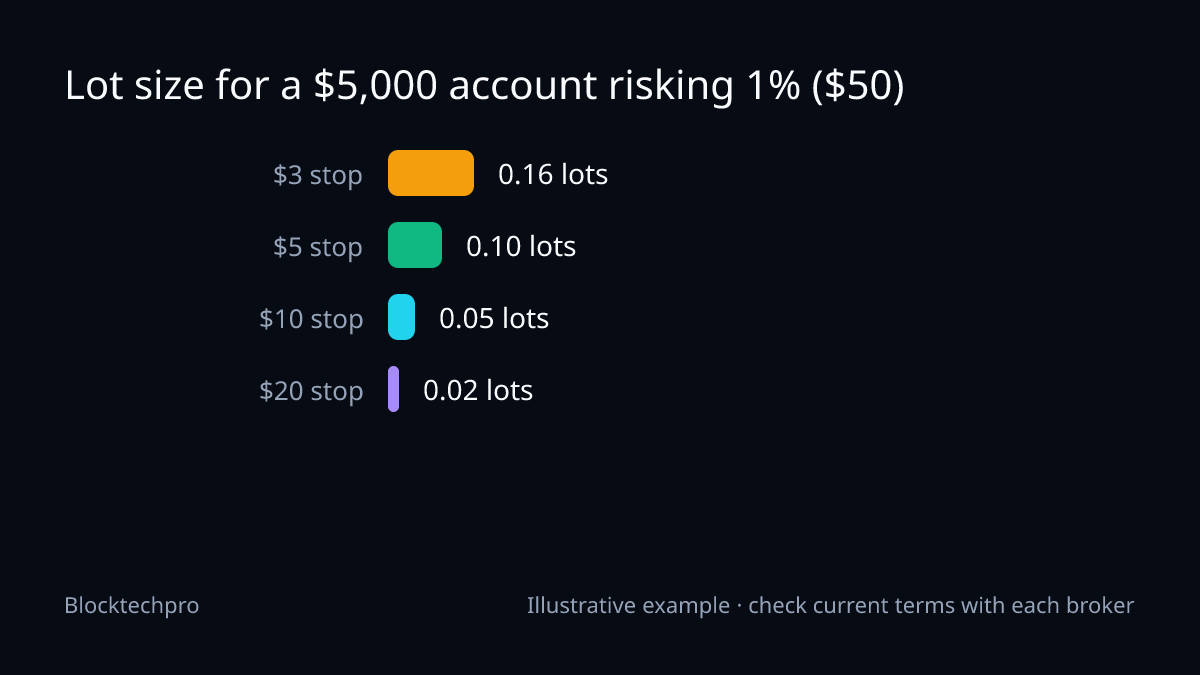
| Balance | 1% at risk | $5 stop | $10 stop | $20 stop |
|---|---|---|---|---|
| $1,000 | $10 | 0.02 lots | 0.01 lots | below minimum* |
| $3,000 | $30 | 0.06 lots | 0.03 lots | 0.01 lots |
| $5,000 | $50 | 0.10 lots | 0.05 lots | 0.02 lots |
| $10,000 | $100 | 0.20 lots | 0.10 lots | 0.05 lots |
*With a $1,000 account, the smallest position (0.01 lots) risks $20 on a $20 stop — 2% of the account. Either use a tighter, still-sensible stop, accept a higher risk on that trade, or skip it.
Why 1%?
The point of a small fixed percentage is to survive losing streaks, which every strategy has. With a 50% win rate, a run of 6–8 losses in a row over a few hundred trades is normal. Compare what ten consecutive losses do to a $10,000 account:
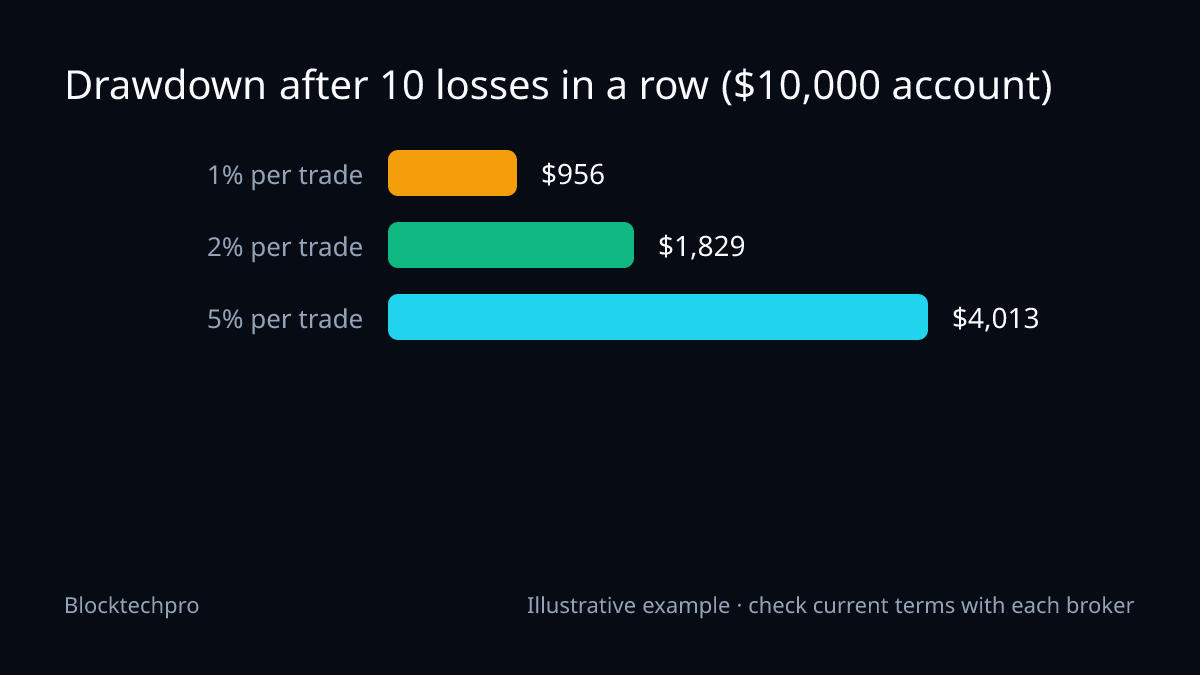
At 1% per trade you are down about 9.6% and need roughly an 11% gain to recover. At 5% you are down about 40% and need a 67% gain. Many professionals risk between 0.5% and 2% per trade; 1% is a sensible default while you are building a track record.
Mistakes that break the formula
- Ignoring the spread. Your stop is triggered on the bid (for a buy), so the effective distance is the stop distance plus the spread. On a tight stop, the spread can be a large share of it.
- Trading through major news. Around releases such as US Non-Farm Payrolls or CPI, gold can gap past your stop. Size down or stay flat if you can't accept a larger loss than planned.
- Moving the stop after entry. Widening a stop without reducing size increases your risk beyond what you calculated.
- Using a non-USD account without converting. If your account is in EUR or another currency, convert the dollar risk into your account currency first.
- Sizing up to earn rebates. Per-lot rebates reduce costs, but they should never influence position size. See our Exness rebate guide for how rebates fit in.
Do it in seconds
The lot size calculator on our home page runs the same formula for gold and major forex pairs. Enter your balance, risk percentage and stop distance, and it returns a position size rounded down to 0.01 lots.
Trading leveraged products carries a high risk of loss. A stop-loss limits risk in normal conditions but does not guarantee a maximum loss.
Topics
- lot size calculator
- XAU/USD
- position sizing
- 1% risk rule
- gold trading
Related guides
All guides →
Exness Rebates Explained: How to Get Cashback on Every Lot You Trade
How Exness rebates (cashback) work, what you can realistically get back per lot, how to set them up on a new or existing account, and the mistakes to avoid.
Bybit Futures Fee Rebates: How Much Active Traders Can Save
Bybit charges 0.055% taker and 0.02% maker on futures. See what that costs at different volumes, how a 30–50% fee rebate works, and other ways to cut fees.
Exness vs XM Rebates: Which Broker Pays More Back Per Lot?
Exness and XM rebates side by side: how each is calculated, typical amounts per lot, payout frequency and account types, plus which suits your trading style.