Exness vs XM Rebates: Which Broker Pays More Back Per Lot?
Exness and XM rebates side by side: how each is calculated, typical amounts per lot, payout frequency and account types, plus which suits your trading style.

Short answer: Exness rebates are a share of the revenue your trading generates, so they rise on wider-spread instruments such as gold; XM rebates through an IB are usually a fixed amount per lot that depends on your account type. For high-volume gold traders Exness often pays more back; for traders who value XM's bonus and loyalty programs, XM can be the better overall package. The details are below.
How Exness rebates work
Exness pays its partners up to 40% of the spread and commission revenue from referred clients, and Blocktechpro passes a share of that back to you. At the full rate that comes to about $3–$16 per standard lot, depending on the instrument and account type. Rebates are paid daily.
Because it is a revenue share, the rebate follows the spread: gold and minor pairs, which have wider spreads, generate larger rebates than EUR/USD. Our Exness rebate guide walks through the setup.
How XM rebates work
XM offers two routes:
- XM Loyalty Program. XM's own scheme awards XM Points (XMP) per lot, which can be redeemed for credit or cash. The value per lot depends on your loyalty tier and is generally lower than an IB rebate.
- IB rebates. XM pays introducing brokers a fixed amount per lot — up to $25 per lot for non-EU clients, depending on account type. The share a rebate partner passes back to you is lower, and accounts with tighter spreads, such as Ultra Low, generate smaller rebates than Standard accounts.
Side-by-side comparison
| Exness | XM | |
|---|---|---|
| How the rebate is set | Share of revenue (up to 40%) | Fixed $ per lot, or loyalty points |
| Partner program pays | Up to 40% of revenue (about $3–$16 per lot) | Up to $25 per lot (non-EU clients) |
| Partner payouts | Daily | Confirmed at sign-up |
| Accounts that earn rebates | Most account types | Mainly Standard and Micro; lower on Ultra Low |
| Bonus programs | Generally none | Deposit and loyalty bonuses in some regions |
Figures are typical ranges and change over time and by region. Check each broker's website for current spreads and fees before you trade.
Worked example: 20 lots a month
A trader who closes 20 standard lots a month would receive roughly:
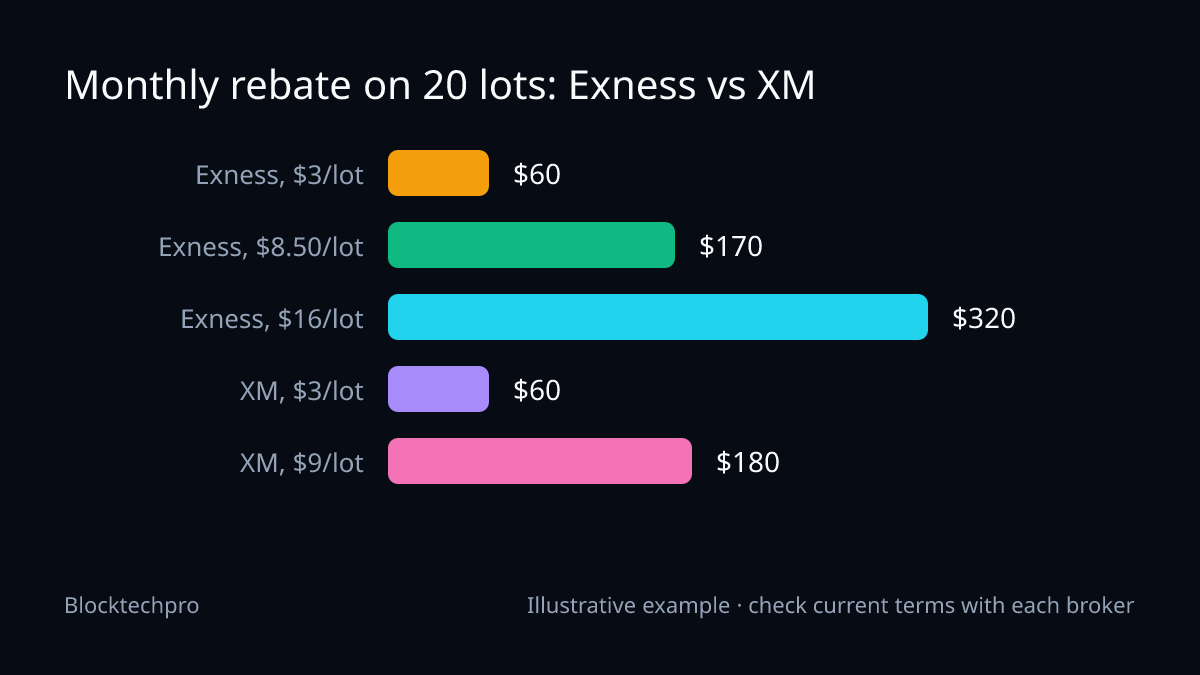
The ranges overlap. On EUR/USD with a tight spread, an Exness rebate can be close to the bottom of its range, similar to XM. On gold, it is usually near the middle or top. What matters is the instrument you trade most.
Look at total cost, not the rebate alone
A big rebate on an account with a wide spread can still cost more than a small rebate on a tight one. Compare:
net cost per lot = spread cost + commission − rebate
For example, if account A costs $20 per lot in spread and pays a $9 rebate, your net cost is $11. If account B costs $7 in spread plus $7 commission and pays a $4 rebate, your net cost is $10 — cheaper despite the smaller rebate. Run this with the real spreads you see on your platform for the instruments you trade.
Which should you choose?
- Mostly gold or minor pairs, high volume: Exness's revenue-share model usually returns more per lot, and daily payouts help cash flow.
- Smaller accounts that value bonuses: XM's deposit and loyalty programs (where available) can add value that a rebate alone does not.
- Either way: check which regulated entity you will be onboarded to in your country, its leverage limits and investor protections, before comparing rebates at all.
How to sign up
- Exness: register through our Exness link. Existing clients can ask Exness support for a partner change; approval is at Exness's discretion.
- XM: open an account through our XM link. Rebates apply to accounts registered under it.
Whichever broker you pick, size trades from your risk, not from the rebate. Our guide to gold lot size and the 1% rule shows how.
Trading forex, CFDs and crypto with leverage carries a high risk of losing money. Rebates reduce costs; they do not offset losses from a strategy that does not work.
Topics
- Exness vs XM
- forex rebates
- XM loyalty program
- broker comparison
- trading costs
Related guides
All guides →
Exness Rebates Explained: How to Get Cashback on Every Lot You Trade
How Exness rebates (cashback) work, what you can realistically get back per lot, how to set them up on a new or existing account, and the mistakes to avoid.
Bybit Futures Fee Rebates: How Much Active Traders Can Save
Bybit charges 0.055% taker and 0.02% maker on futures. See what that costs at different volumes, how a 30–50% fee rebate works, and other ways to cut fees.
How to Calculate Lot Size for Gold (XAU/USD) with the 1% Risk Rule
Step-by-step formula for gold position size: 1 lot is 100 oz, so a $1 move is worth $100 per lot. Worked examples for $1,000–$10,000 accounts and common mistakes.