
Exness Account Types: Standard, Cent, Pro, Raw Spread and Zero Compared
Compare Exness Standard, Standard Cent, Pro, Raw Spread and Zero on spreads, commission and deposit rules, with a worked break-even example per lot.
- Written by Blocktechpro Editorial Team
- Edited by Blocktechpro Editorial Team
- Fact-checked against verified broker disclosures,
Exness offers five account types: Standard and Standard Cent (no commission), and the Professional group of Pro, Raw Spread and Zero (lower spreads, with commission). Standard suits most traders who want simple pricing. Raw Spread or Zero tends to suit active traders, but only if the spread saving is bigger than the commission. This guide shows how to test that with simple arithmetic.
Exness account types at a glance
The table uses only figures Exness publishes. Where a figure is not in our verified sources, we say so instead of guessing.
| Account | Spread | Commission | Minimum deposit rule |
|---|---|---|---|
| Standard | From 0.2 pips | None | No fixed minimum; depends on payment method and/or region |
| Standard Cent | Check Exness | Check Exness | No fixed minimum; depends on payment method and/or region |
| Pro | Check Exness | Check Exness | Region-based; Help Center says at least 200 USD depending on regional requirements |
| Raw Spread | From 0.0 pips | Up to $3.50 each side per lot (up to $7.00 round turn) | Region-based; at least 200 USD depending on regional requirements |
| Zero | From 0.0 pips; zero spread on the top 30 instruments, which may rise above 0 in high volatility | From $0.05 each side per lot | Region-based; at least 200 USD depending on regional requirements |
Sources: Exness Standard accounts page, Exness Professional accounts page and Exness Help Center: Trading account types.
Standard and Standard Cent
Standard has spreads from 0.2 pips and no commission, so the spread is your whole trading cost per trade. Standard and Standard Cent have no fixed minimum initial deposit. The minimum first deposit depends on the payment method you choose and/or your region (Exness Help Center: minimum amount needed to start trading).
Standard Cent is the same no-fixed-minimum group. We have no verified spread or contract-size figures for it, so check its details on Exness before you rely on it.
Pro, Raw Spread and Zero
These three are the Professional accounts. They have a region-based minimum first deposit, which the Help Center says is at least 200 USD depending on regional requirements. After the first deposit, the minimum depends only on the payment method. For region examples, see Exness Minimum Deposit: Standard vs Pro, Raw Spread and Zero.
- Raw Spread: spreads from 0.0 pips, with commission of up to $3.50 each side per lot. That is up to $7.00 per lot round turn ($3.50 x 2).
- Zero: zero spread on the top 30 instruments, though spreads on them may rise above 0 in high volatility. Commission is quoted as from $0.05 each side per lot. That is a minimum, not necessarily the rate on the pair you trade, so read the commission for your instrument on the Exness page.
- Pro: we have no verified spread or commission figures, so check the Exness Professional accounts page.
Worked example: when does Raw Spread beat Standard?
Use this formula: net cost per lot = spread cost + commission − rebate. Spread cost = spread in pips x pip value x lots. On EUR/USD, one pip is $10 per standard lot (100,000 units). You can check other pairs with our Pip Calculator.
Raw Spread at the maximum published commission costs $3.50 x 2 = $7.00 per lot round turn. That equals $7.00 / $10 = 0.7 pip. So at that commission, Raw Spread only wins if its spread is more than 0.7 pip tighter than Standard's on the same pair at the same time.
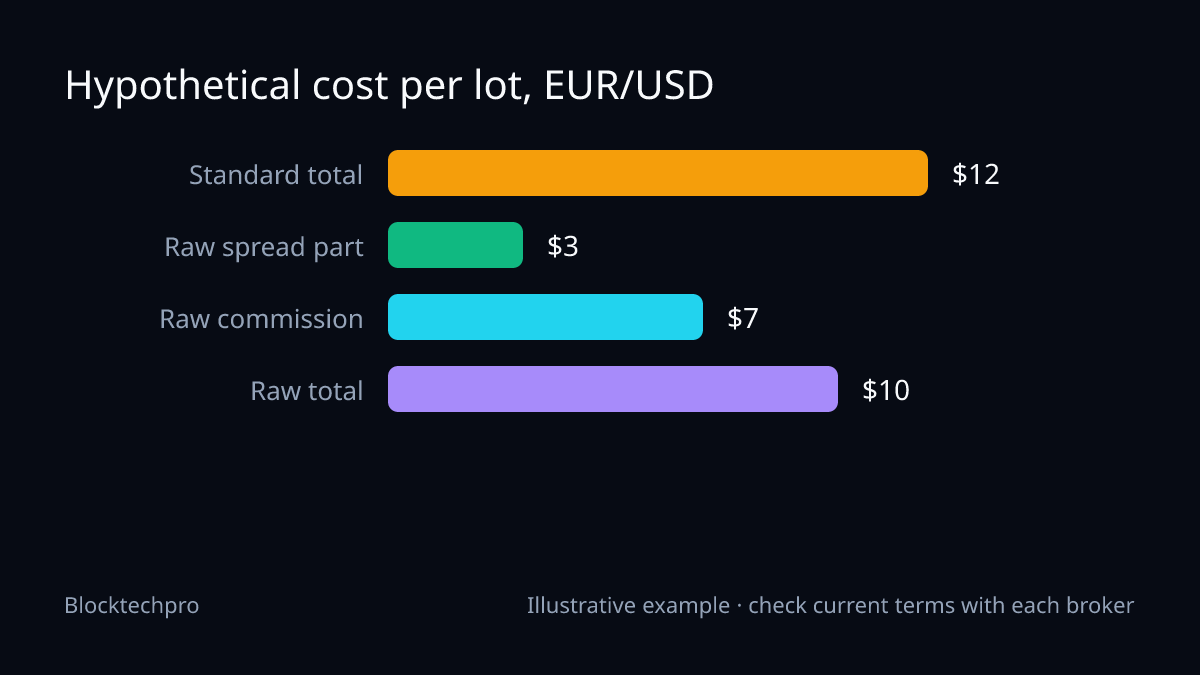
Example only. The spreads below are hypothetical inputs for illustration, not quoted Exness spreads. Assume EUR/USD, 1 lot, Standard at 1.2 pips and Raw Spread at 0.3 pips:
- Standard: 1.2 x $10 x 1 = $12.00, no commission, total $12.00.
- Raw Spread: 0.3 x $10 x 1 = $3.00, plus $7.00 commission, total $10.00.
The gap here is 0.9 pip, which is more than 0.7, so Raw Spread saves $2.00 per lot. At 5 lots that is $10.00 saved. If the real gap were only 0.5 pip, Standard would be cheaper. Measure actual spreads on your own platform at the times you trade.
How to choose
- Small account, low volume: Standard or Standard Cent has no fixed minimum and no commission to track.
- Higher volume or scalping: compare live Standard and Raw/Zero spreads on your pairs, then run the 0.7 pip test above with the commission you actually pay.
- Gold and indices: pip definitions differ. On XAU/USD, a $0.10 move is $10 per lot, but some brokers count $0.01 as a pip, so use our XAUUSD Pip Calculator before comparing.
- Swaps: if you hold overnight, swaps vary by instrument, direction and broker. They are shown in the platform's contract specification.
Regulation and availability
Exness entities are regulated by the FSA (Seychelles, Exness (SC) Ltd, licence SD025), the FSCA (South Africa), the CBCS (Curaçao), the FSC (BVI), the FSC (Mauritius) and the CMA (Kenya). The FCA and CySEC entities accept professional clients only, and the global site does not serve UK or EEA residents. Exness also does not serve residents of the USA, Canada, Europe, the UK, Russia and Belarus on the global site. Residents of Kenya are directed to a Kenya-dedicated site that Exness says is regulated by the CMA (Exness Standard accounts page). Which entity serves you depends on where you live, so confirm this on the Exness website. For Kenya details, see Exness Kenya: Kenya Site, Account Types, Deposit and Trading Costs.
Where rebates fit in
The Exness partner program pays up to 40% of Exness revenue from referred clients' trades, as published by the broker. Blocktechpro passes a share of that back to the trader, and the exact share is confirmed at sign-up. You do not receive the full partner rate. Exness pays its partners on daily or instant options, which describes the broker's partner payout, not when you are paid.
When you open an account, the registration form has a Partner code field after the email and password. The code for Blocktechpro is ccm34k1you. You can open an Exness account through our partner link and enter it there. Source: Exness Help Center: Registering an Exness account. If you already have an account, Exness support is the place to ask whether and how the partner can be changed. See How to Change Partner on Exness and the Exness Rebate Guide for the full process.
Risk warning
Leveraged forex and CFD trading can lose money quickly. Rebates do not offset trading losses, and a cheaper account type does not make a losing strategy profitable. Spreads, commissions, minimum deposits and availability vary by country and change over time, so confirm them on the official Exness website. Read our risk disclaimer before you trade.
Topics
- Exness
- account types
- spreads and commission
- raw spread
- minimum deposit
Related guides
All guides →
Forex Cashback: Where the Money Comes From and What It Means Per Lot
Forex cashback is a share of the broker's partner payment passed back to you on each lot. See where it comes from, worked cost examples and how to claim it.
Gold Lot Size for a $500 and $1,000 Account: 1% Risk Table
At 1% risk, a $500 account risks $5 and a $1,000 account risks $10 per gold trade. See the lot size for each stop distance, and what 0.01 and 0.10 lot is worth per $1 move.
Gold Lot Size: What 1.00, 0.10 and 0.01 Lots Mean on XAU/USD
On most platforms 1.00 lot of gold is 100 oz, 0.10 is 10 oz and 0.01 is 1 oz. See what a $1 move is worth and how to pick a lot size from risk %.