
Gold Lot Size for a $500 and $1,000 Account: 1% Risk Table
At 1% risk, a $500 account risks $5 and a $1,000 account risks $10 per gold trade. See the lot size for each stop distance, and what 0.01 and 0.10 lot is worth per $1 move.
- Written by Blocktechpro Editorial Team
- Edited by Blocktechpro Editorial Team
- Fact-checked against verified broker disclosures,
At 1% risk, a $500 account risks $5 and a $1,000 account risks $10 on each gold trade. With a $5 stop on XAU/USD, that means about 0.01 lot on $500 and 0.02 lot on $1,000. On gold, 0.01 lot is worth $1 per $1 move and 0.10 lot is worth $10 per $1 move. The table below covers other stop distances.
The formula
One standard lot of XAU/USD is 100 oz, so a $1 price move is worth $100 per lot. Lot size is your dollar risk divided by the stop distance in dollars times 100:
lots = risk in $ / (stop distance in $ x 100)
Pip definitions differ: some brokers count a $0.10 move as one pip ($10 per lot), others count $0.01. That is why this guide uses dollar moves, which are the same everywhere. For the pip-based version, see XAU/USD lot size for 1% risk.
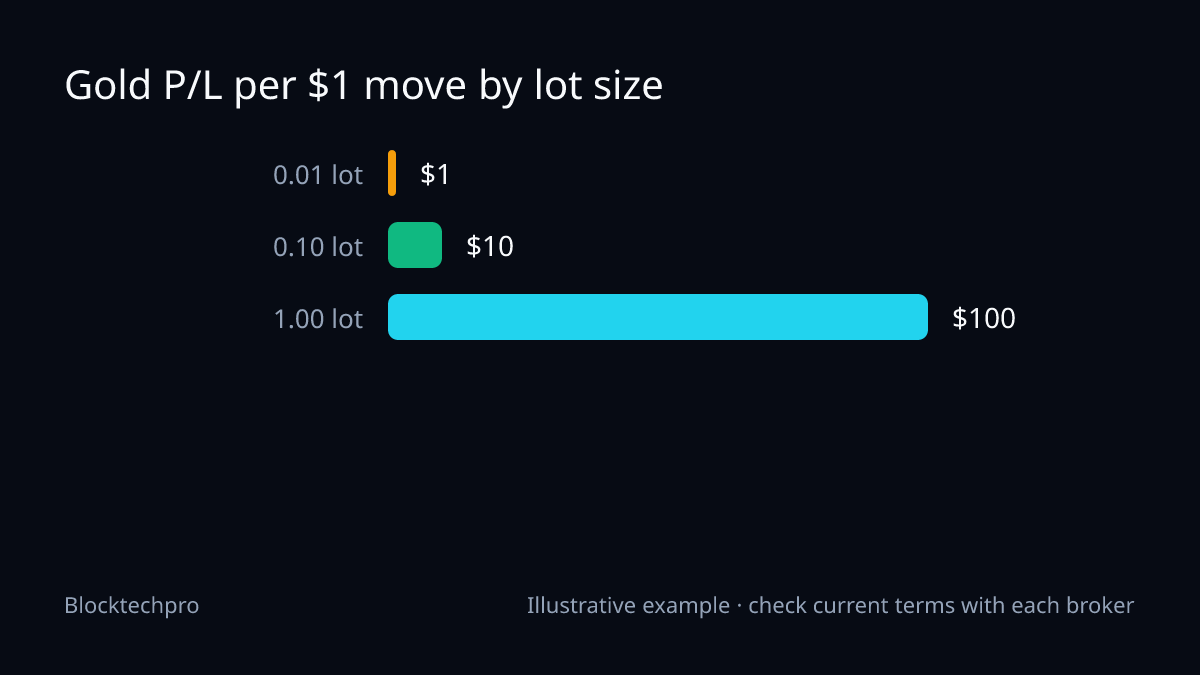
What 0.01, 0.10 and 1.00 lot are worth per $1 move
| Lot size | Ounces | Value of a $1 move | Value of a $0.10 move |
|---|---|---|---|
| 0.01 | 1 oz | $1 | $0.10 |
| 0.10 | 10 oz | $10 | $1 |
| 1.00 | 100 oz | $100 | $10 |
So a 0.10 lot position gains or loses $10 for every $1 gold moves. That is 10 oz x $1. For a deeper look at lot sizes, read what 1.00, 0.10 and 0.01 lots mean on XAU/USD.
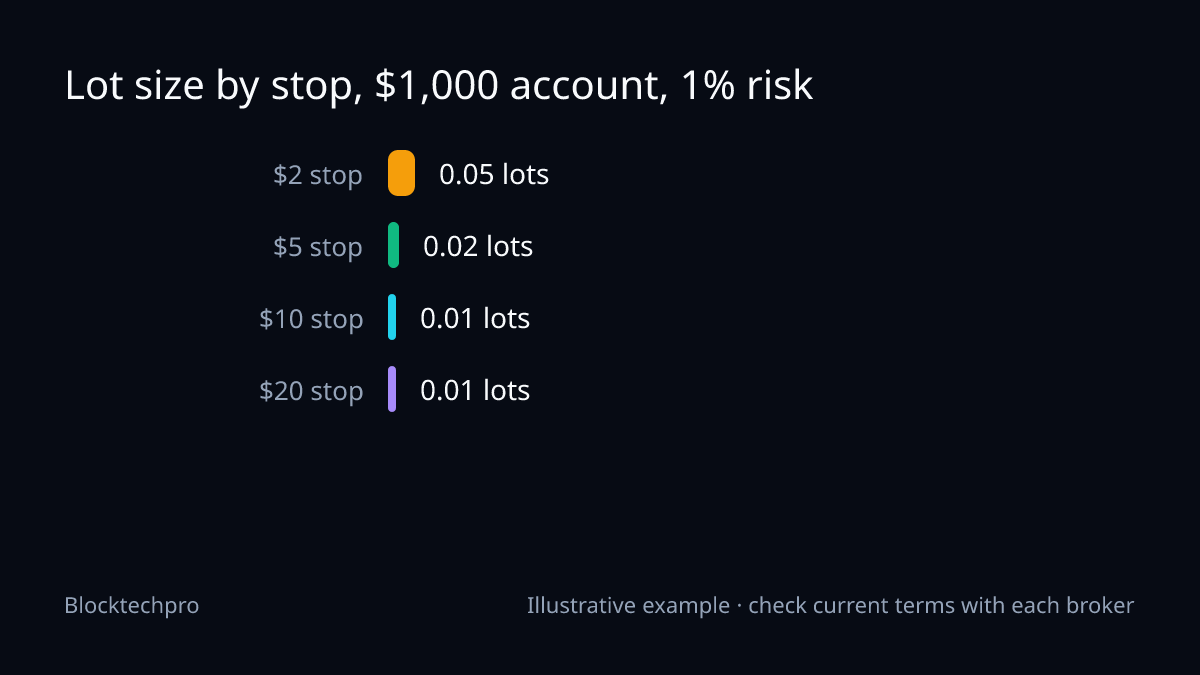
Lot size table: $500 and $1,000 at 1% risk
Example calculation. Risk is $5 on $500 (1% x $500) and $10 on $1,000 (1% x $1,000).
| Stop distance | $500 account ($5 risk) | $1,000 account ($10 risk) |
|---|---|---|
| $2 | 5 / 200 = 0.025, use 0.02 | 10 / 200 = 0.05 |
| $5 | 5 / 500 = 0.01 | 10 / 500 = 0.02 |
| $10 | 5 / 1,000 = 0.005, below 0.01 | 10 / 1,000 = 0.01 |
| $20 | 5 / 2,000 = 0.0025, below 0.01 | 10 / 2,000 = 0.005, below 0.01 |
Round down, never up, so your real risk stays at or under 1%. Using 0.02 lot on a $500 account with a $2 stop risks 0.02 x 100 x $2 = $4, which is 0.8%.
When the minimum lot is bigger than your 1% risk
Many brokers set 0.01 lot as the smallest size. If the formula gives less than that, the smallest trade already risks more than 1%:
- $500 account, $10 stop, 0.01 lot: 0.01 x 100 x $10 = $10 risk, which is 2%.
- $500 account, $20 stop, 0.01 lot: 0.01 x 100 x $20 = $20 risk, which is 4%.
- $1,000 account, $20 stop, 0.01 lot: $20 risk, which is 2%.
In these cases, tighten the stop only if the chart supports it, skip the trade, or accept the higher risk knowingly. Do not set a stop too tight just to fit the lot size. Check your broker's minimum lot in the platform's contract specification.
Why 0.10 lot is usually too big for these accounts
The search for "0.10 lot size in gold" often comes from traders who want to know how much that position can lose. At 0.10 lot, a $5 adverse move costs 0.10 x 100 x $5 = $50. That is 10% of a $500 account and 5% of a $1,000 account. A $10 move costs $100, which is 20% of $500 and 10% of $1,000. For 1% risk, 0.10 lot only fits a $1,000 account if the stop is $1 away (0.10 x 100 x $1 = $10).
Margin check (hypothetical example)
Margin depends on your broker's leverage and the gold price. Using a hypothetical price for illustration of 2,400.00 and an assumed leverage of 1:100:
- 0.01 lot: 1 oz x 2,400 = $2,400 notional, margin $2,400 / 100 = $24.
- 0.10 lot: 10 oz x 2,400 = $24,000 notional, margin $24,000 / 100 = $240.
Margin is not risk; your stop sets the risk. But a large margin share leaves little room if the trade moves against you. Use the Margin Calculator with your broker's real leverage.
Trading costs matter more on small accounts
Spread cost is the spread in dollars x ounces. With a hypothetical $0.20 spread (illustration only, not a quote), 0.01 lot costs 0.20 x 1 oz = $0.20 and 0.10 lot costs 0.20 x 10 oz = $2.00. On a $500 account, $2.00 is 0.4% of the balance before the trade has moved.
Commissions add to this. Exness lists its Standard account with spreads from 0.2 pips and no commission (Exness Standard accounts page). Its Raw Spread account has spreads from 0.0 pips and commission up to $3.50 each side per lot (Exness Professional accounts page), which is up to $7.00 per lot round turn ($3.50 x 2). On 0.10 lot that is up to $0.70 per round trip ($7.00 x 0.10). Gold's spread behavior and any commission on it can differ from forex pairs, so check the instrument's specification.
Deposit rules matter too. Exness says Standard accounts have no fixed minimum initial deposit, while Professional accounts need a first deposit of at least 200 USD, depending on regional requirements (Exness Help Center: Trading account types). Exness does not serve residents of some regions, including the USA, Canada, Europe and the UK.
If you hold gold overnight, swaps apply. They vary by instrument, direction and broker and are shown in the platform's contract specification, so check them before holding a position.
Rebates on small accounts
Exness pays its partners up to 40% of Exness revenue from your trades, as published by the broker. Blocktechpro passes a share of that back to the trader, and the exact share is confirmed at sign-up. You can check the Exness rebate details here; partner code ccm34k1you is entered at registration. A rebate lowers your net cost per lot (spread cost + commission − rebate). It does not change how much a stop-out loses.
Step by step
- Take 1% of your balance: $5 on $500, $10 on $1,000.
- Set your stop where the trade idea is wrong, and measure it in dollars.
- Divide the risk by the stop distance x 100.
- Round down to your broker's lot step.
- If the result is below the minimum lot, recheck the stop or skip the trade.
The Gold Lot Size Calculator does this for any balance, risk percentage and stop distance.
Risk warning
Leveraged forex and CFD trading, including gold, can lose money quickly, and fast markets can fill your stop beyond the level you set. Rebates do not offset trading losses. Read our risk disclaimer and confirm fees, leverage and contract specifications on your broker's official website. All figures above are examples, not advice.
Topics
- XAU/USD lot size
- small account
- 1% risk
- gold trading
Related guides
All guides →
Gold Lot Size: What 1.00, 0.10 and 0.01 Lots Mean on XAU/USD
On most platforms 1.00 lot of gold is 100 oz, 0.10 is 10 oz and 0.01 is 1 oz. See what a $1 move is worth and how to pick a lot size from risk %.
Exness Kenya: Kenya Site, Account Types, Deposit and Trading Costs
Exness Kenya explained: the Kenya-dedicated site, account types, deposit rules and a per-lot cost example, with sources.
Exness Minimum Deposit: Standard vs Pro, Raw Spread and Zero
Exness Standard has no fixed minimum first deposit, while Pro, Raw Spread and Zero need at least 200 USD, depending on region. See how payment method matters.