Exness Minimum Deposit: Standard vs Pro, Raw Spread and Zero
Exness Standard has no fixed minimum first deposit, while Pro, Raw Spread and Zero need at least 200 USD, depending on region. See how payment method matters.
- Written by Blocktechpro Editorial Team
- Edited by Blocktechpro Editorial Team
- Fact-checked against verified broker disclosures,
Short answer: Exness Standard and Standard Cent accounts have no fixed minimum initial deposit. The minimum first deposit depends on the payment method you choose and/or your region. Professional accounts (Pro, Raw Spread, Zero) have a region-based minimum, and the Exness Help Center says they need a first deposit of at least 200 USD, depending on regional requirements. Source: Exness Help Center: Trading account types.
So there is no single number that applies to everyone. The sections below show what is fixed, what varies, and how to find your exact figure before you send money.
Minimum first deposit by account type
| Account | Minimum first deposit | What decides it |
|---|---|---|
| Standard / Standard Cent | No fixed minimum | Payment method and/or region |
| Pro, Raw Spread, Zero | At least 200 USD | Region-based requirement |
After the first deposit, the minimum depends only on the payment method. Source: Exness Help Center: What is the minimum amount needed to start trading?
How payment method and region change the number
For a Standard account, the payment method is often the real floor. Each deposit option has its own minimum, so a card, an e-wallet and a bank transfer can differ. We do not list per-method amounts here because we have not verified them. Open the deposit page inside your Exness Personal Area, pick the method, and read the minimum shown before you confirm.
Region matters in two ways: the minimum for Professional accounts, and which Exness entity serves you.
- South Africa: Exness lists the FSCA (South Africa) among its regulators. Check the regional minimum for your chosen account type in the Personal Area.
- Nigeria: we have no verified country-specific minimum. Use the figure shown at deposit.
- Kenya: residents are directed to a Kenya-dedicated Exness website, which Exness says is regulated by Kenya's Capital Markets Authority (CMA). Confirm the minimums on that site.
- Not served: the global entities do not serve residents of the USA, Canada, Europe, the UK, Russia and Belarus.
Sources: Exness Standard accounts page and Exness website footer.
Which account suits a small first deposit?
A lower deposit limit does not mean lower trading cost. The accounts price differently:
- Standard: spreads from 0.2 pips, no commission. Source: Exness Standard accounts page.
- Raw Spread: spreads from 0.0 pips, commission up to $3.50 each side per lot, which is up to $7.00 per lot round turn ($3.50 x 2).
- Zero: spreads from 0.0 pips, with zero spread on the top 30 instruments (it may rise above 0 in high volatility), and commission from $0.05 each side per lot. That is a starting figure, so check the fee page for the instrument you trade.
Source for the last two: Exness Professional accounts page.
Worked example: what commission adds
This is an example only. It uses one hypothetical spread of 1.0 pip on EUR/USD for both accounts, to isolate the commission. Real spreads differ by account and conditions. Pip value is $10 per pip per standard lot (100,000 units).
- Spread cost = 1.0 pip x $10 x 1 lot = $10.00
- Standard: $10.00 + $0 commission = $10.00 per lot
- Raw Spread: $10.00 + $7.00 (up to, round turn) = $17.00 per lot
- At 0.10 lot: spread cost = 1.0 x $10 x 0.10 = $1.00. Standard = $1.00, Raw Spread = $1.00 + $0.70 = $1.70.
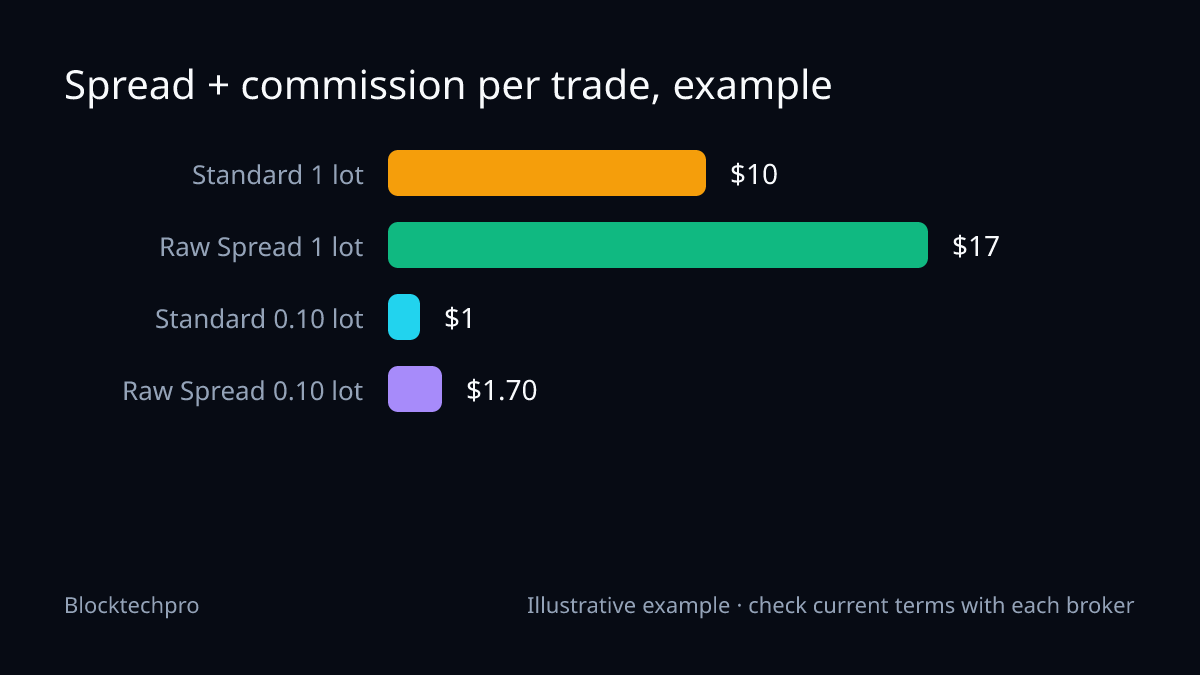
The point is that Raw Spread only comes out cheaper if its tighter spread saves more than the commission. Compare real spreads on your instrument in the platform. Net cost per lot = spread cost + commission − rebate.
Deposit size and position size are different things
A bigger deposit does not make a trade safer. What protects the account is sizing each trade to a fixed risk. Try the Position Size Calculator and the Margin Calculator with your intended deposit, and the Pip Calculator to check pip value.
Does a rebate change the deposit?
No. The partner code does not change what you must deposit. The Exness partner program pays up to 40% of Exness revenue from your trades, as published by the broker. Blocktechpro passes a share of that back, and the exact share is confirmed at sign-up. You do not receive the full partner rate. The Help Center says the Partner code field sits after email and password during registration. Source: Exness Help Center: Registering an Exness account.
You can open an Exness account with partner code ccm34k1you and see the minimum shown for your region before depositing. For details, read how to use the Exness partner code and the Exness rebate guide.
Checklist before you fund
- Pick the account type: Standard or Standard Cent, or Pro, Raw Spread or Zero.
- Confirm your country is served by the entity you register with.
- Open the deposit page, choose the payment method and read its minimum.
- For a Professional account, expect at least 200 USD, depending on regional requirements.
- Check swaps in the platform's contract specification. They vary by instrument, direction and broker.
Terms change and vary by country, so confirm everything on the official Exness website.
Risk warning
Leveraged forex and CFD trading can lose money quickly, and you can lose more than you expected on a single trade. Rebates reduce costs but do not offset trading losses. Only trade money you can afford to lose, and read our risk disclaimer.
Topics
- Exness
- minimum deposit
- Raw Spread
- Standard account
- trading costs
Related guides
All guides →
Is Forex Trading Legal in India? FEMA Rules and RBI Alert List Explained
Learn how forex trading is regulated in India under FEMA, what the RBI Alert List entails, and how to verify platform authorization.
Exness Partner Code: How to Use ccm34k1you for Trading Rebates
Learn how to use the Exness partner code ccm34k1you during registration to access trading rebates. Compare Exness account costs and minimum deposits.
How to Change Partner on Exness to Receive Trading Rebates
Learn how to switch your Exness partner or Introducing Broker to start earning daily cashback rebates on your forex and CFD trades.