
IC Markets Minimum Deposit: $0 on Standard and Raw Spread, and What That Means for Costs
IC Markets lists a $0 minimum deposit on its Standard and Raw Spread (MetaTrader) accounts. See the account costs, a worked example and what to check first.
- Written by Blocktechpro Editorial Team
- Edited by Blocktechpro Editorial Team
- Fact-checked against verified broker disclosures,
IC Markets lists a $0 minimum deposit on both its Standard and Raw Spread (MetaTrader) accounts. The Standard account has spreads from 0.8 pips and $0 commission. The Raw Spread account has spreads from 0.0 pips and a commission of $3.50 per lot per side. Source: IC Markets (IC) account overview.
A $0 minimum only tells you how little you need to open the account. It says nothing about how much you need to trade sensibly. This guide covers the minimum by account type, what each account costs per lot, and what to check for your region before you fund anything.
IC Markets minimum deposit by account type
| Account | Spreads from | Commission | Minimum deposit |
|---|---|---|---|
| Standard (MetaTrader) | 0.8 pips | $0 | $0 |
| Raw Spread (MetaTrader) | 0.0 pips | $3.50 per lot per side ($7.00 round turn) | $0 |
| Raw Spread (cTrader) | 0.0 pips | $3.00 per USD 100k traded | Not listed in the figures we verified; check the official page |
Sources: IC Markets (IC) account overview and IC Markets EU account overview. The $7.00 round-turn figure is our arithmetic: $3.50 x 2.
If you plan to use cTrader, confirm the minimum on the official account page before you register. We do not state a figure we have not verified.
Why the minimum deposit is not the full story
Three things can still affect how much you actually fund:
- Payment method. Your deposit method may have its own limits or fees. Check these in the client area, not in a guide.
- Your region and entity. IC Markets operates through several entities. These include Raw Trading Ltd (IC Markets Global, FSA Seychelles licence SD018), IC Markets (EU) Ltd (CySEC licence 362/18), International Capital Markets Pty Ltd (ASIC AFSL 335692), IC Markets (KE) Limited (CMA Kenya licence 199) and IC Markets Ltd (Securities Commission of The Bahamas, SIA-F214). Which one serves you depends on where you live, and terms can differ by entity. Confirm yours on the official site.
- Margin and position size. A tiny account can only carry tiny positions. Use the Margin Calculator and the Lot Size Calculator before you decide how much to deposit.
Note that "IC" and "IC Markets Global" are trading names of Raw Trading Ltd, and icmarkets.com redirects to ic.com. Source: IC Markets (IC) account overview.
Worked example: what each account costs per trade
The formulas are:
- Spread cost = spread in pips x pip value x lots
- Net cost per lot = spread cost + commission − rebate
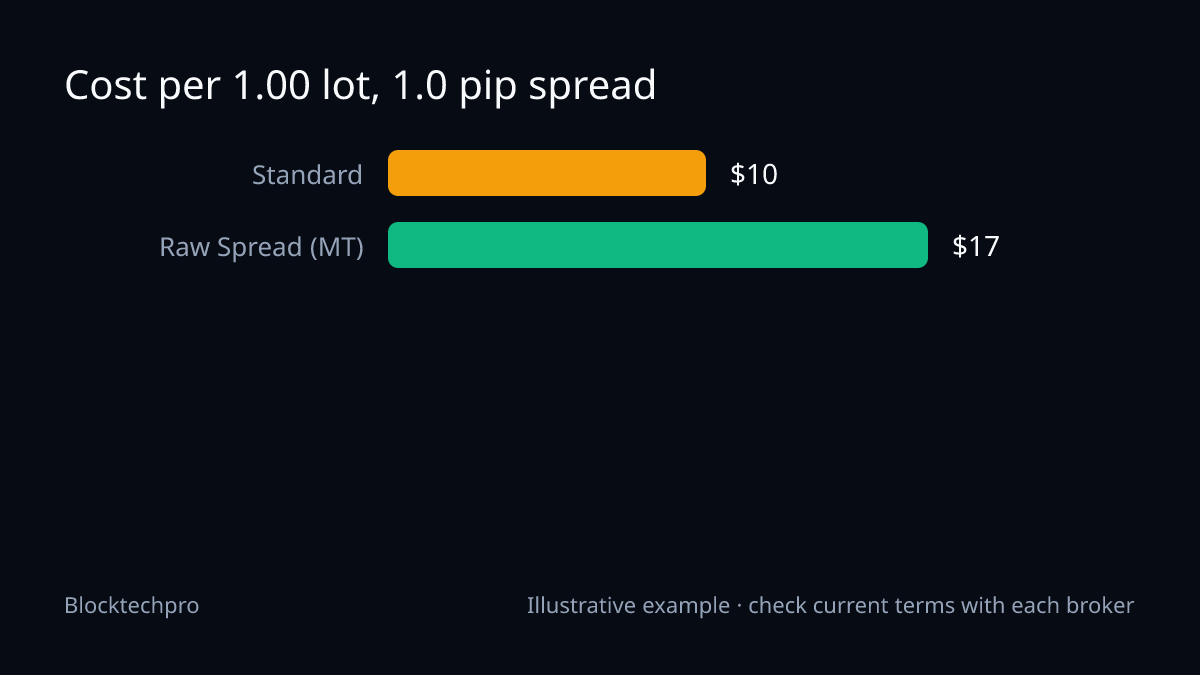
On EUR/USD, one pip is $10 per standard lot of 100,000. For this example only we use the same hypothetical spread of 1.0 pip on both accounts. It is not a quoted spread, so the comparison isolates the commission.
- Standard, 1.00 lot: 1.0 x $10 x 1 = $10.00 spread + $0 commission = $10.00.
- Raw Spread (MetaTrader), 1.00 lot: 1.0 x $10 x 1 = $10.00 spread + ($3.50 x 2) = $7.00 commission = $17.00.
This is before any rebate. IC Markets does not publish a partner rate on the pages we checked, so we show $0 rebate here.
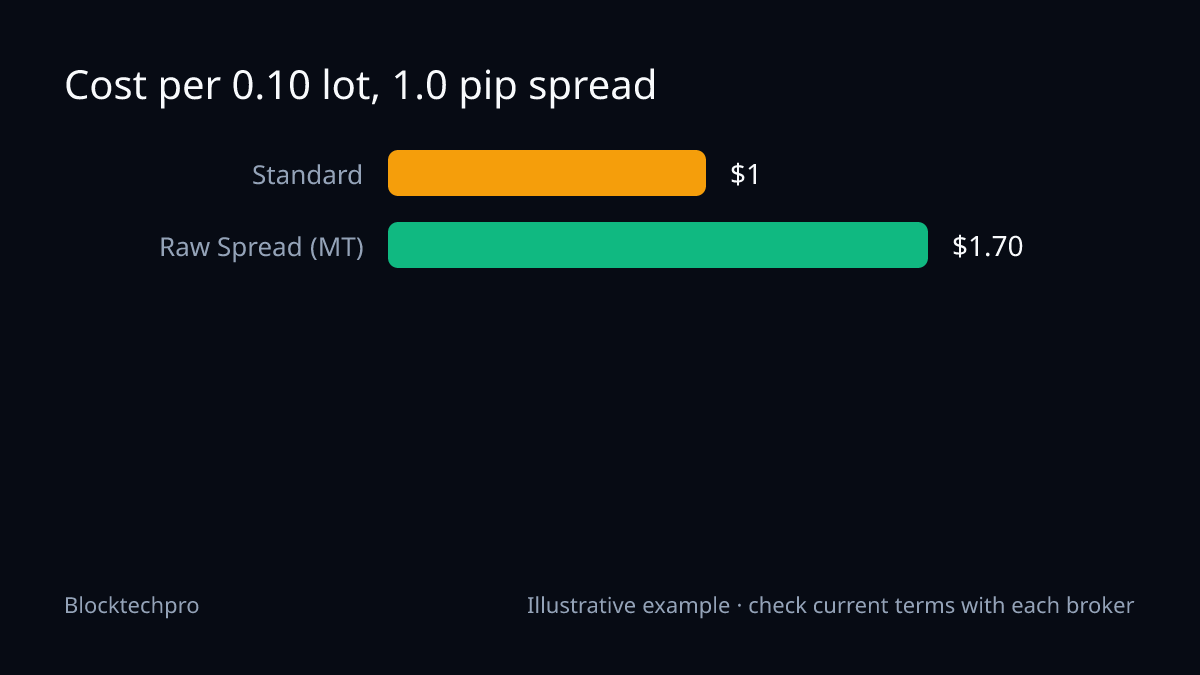
Now scale it to 0.10 lots, a more realistic size for a small account:
- Standard: 1.0 x $10 x 0.10 = $1.00.
- Raw Spread (MetaTrader): $1.00 spread + ($3.50 x 2 x 0.10 = $0.70) = $1.70.
Real spreads move with the instrument and market conditions. In practice Raw Spread usually looks cheaper only when its actual spread is lower than Standard's by more than the commission. Compare live spreads on a demo account to find out. Swaps (overnight financing) also apply if you hold positions open. They vary by instrument, direction and broker and are shown in the platform's contract specification.
Rebates and a low deposit
A rebate reduces your net cost per lot, but it does not change the minimum deposit. The IC Markets partner program pays its maximum rate as published by the broker, and that rate is not published: it is confirmed at sign-up. Blocktechpro passes a share of it back to the trader, and the exact share is also confirmed at sign-up. You should never assume you receive the full partner rate. For the general mechanics, read Forex Cashback: Where the Money Comes From and What It Means Per Lot.
To see the current terms before you register, you can open the IC Markets page through our partner link and check the account details for your region.
Checklist before you deposit
- Open the official IC Markets account overview for your region and confirm the minimum deposit for the exact account and platform you want.
- Check which entity you would be registered with and its regulator.
- Check deposit method limits and fees in the client area.
- Test spreads on a demo account, then work out your cost per lot with the formulas above.
- Size positions from your stop distance and risk, not from the account minimum.
Risk warning
Leveraged forex and CFD trading can lose money quickly, and a $0 minimum deposit does not make it safer. Rebates reduce costs but do not offset trading losses. Broker terms vary by country and change over time. Read our risk disclaimer and confirm all terms on the IC Markets website before you trade. This is not financial advice.
Topics
- IC Markets
- minimum deposit
- Raw Spread
- Standard account
- trading costs
Related guides
All guides →
Exness Withdrawal: How It Works and What to Check Before You Request One
How an Exness withdrawal works, what to check first (payment method, entity, open positions, costs) and where to confirm current limits and fees.
Exness Review: Account Costs, Deposits, Regulation by Entity and Who Cannot Open an Account
A fact-based Exness review: Standard, Raw Spread and Zero costs, minimum deposits, regulators by entity, and which residents cannot open an account.
Exness Account Types: Standard, Cent, Pro, Raw Spread and Zero Compared
Compare Exness Standard, Standard Cent, Pro, Raw Spread and Zero on spreads, commission and deposit rules, with a worked break-even example per lot.