XAU/USD Pip Value per Lot: Exact Calculation and Formula
Learn the exact pip value for XAU/USD per standard, mini, and micro lot, how gold price increments work, and how to calculate risk accurately.

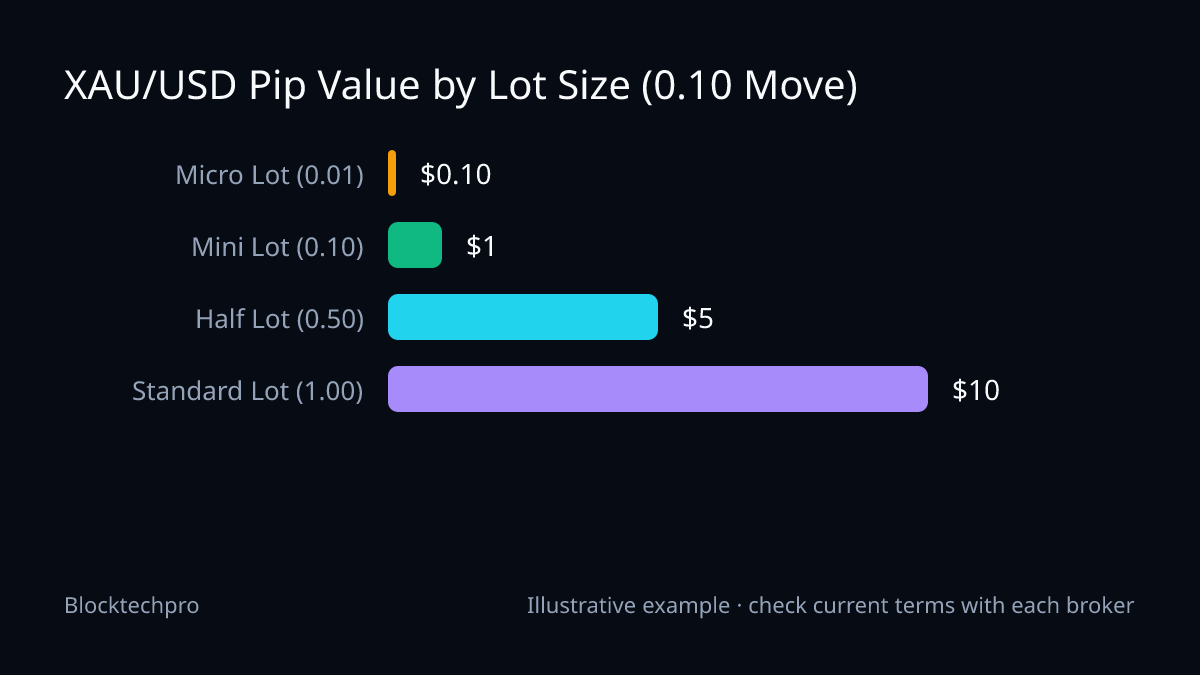
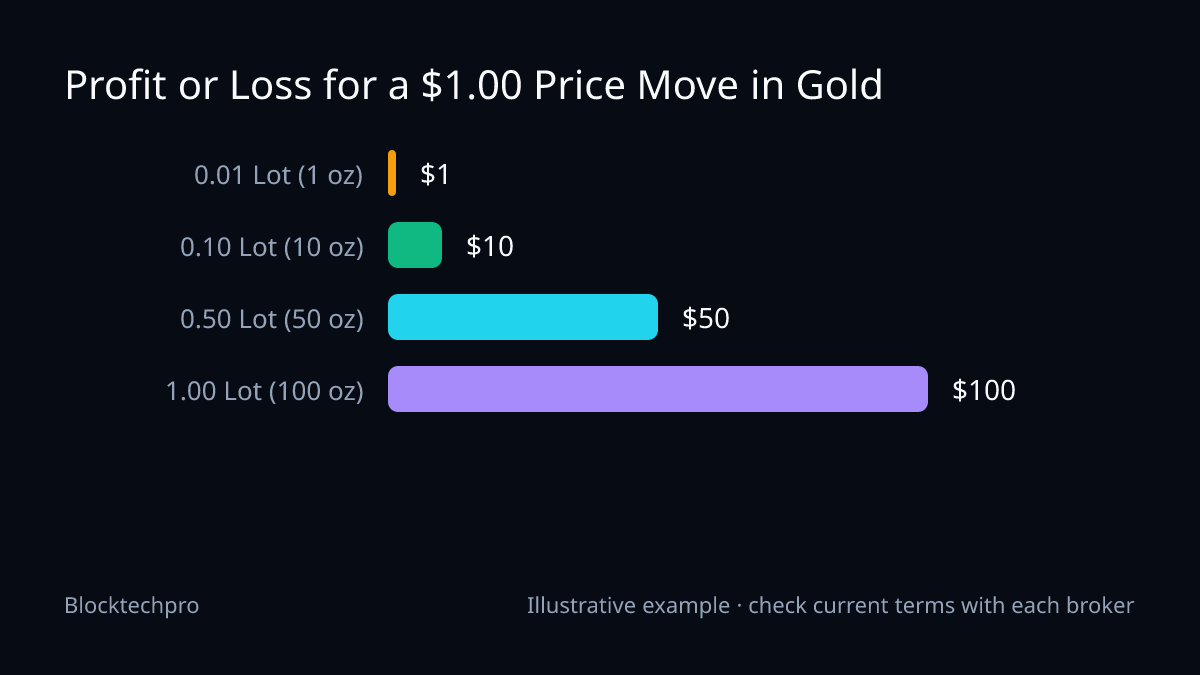
On a standard 1.0 lot of XAU/USD (100 troy ounces of gold), a standard 1-pip movement ($0.10 price change) is worth exactly $10.00 USD. For a full $1.00 price move in gold, a 1.0 standard lot gains or loses $100.00 USD. If you trade a mini lot (0.10) or a micro lot (0.01), that pip value scales down proportionally to $1.00 and $0.10 respectively.
Understanding this arithmetic is essential before entering any gold trade. Because gold is quoted in dollars per ounce, its tick structure differs from currency pairs like EUR/USD, and confusing pips with points can lead to miscalculated risk.
Contract Specifications: Ounces per Lot
In spot gold trading (symbol: XAU/USD), 1 standard lot represents 100 troy ounces of gold. The contract sizing across standard trading tiers breaks down as follows:
- Standard Lot (1.00): 100 troy ounces
- Mini Lot (0.10): 10 troy ounces
- Micro Lot (0.01): 1 troy ounce
Because the quote currency is the US dollar (USD), calculating your monetary exposure does not require currency conversion if your account base currency is also USD.
Pip vs. Point in Gold Trading
Most modern brokers quote XAU/USD with two decimal places (e.g., $2,350.50), while some use three decimal places (e.g., $2,350.505) for fractional pricing. The industry conventions are:
- 1 Cent ($0.01): Often defined as 1 point (or tick). On 1.0 standard lot (100 oz), a $0.01 shift equals $1.00 (100 oz × $0.01).
- 10 Cents ($0.10): The conventional "pip" in MetaTrader terminal metrics for gold. On 1.0 standard lot, a $0.10 shift equals $10.00 (100 oz × $0.10).
- 1 Dollar ($1.00): A full point move in the underlying commodity price. On 1.0 standard lot, a $1.00 shift equals $100.00 (100 oz × $1.00).
To avoid ambiguity across broker terminals, always verify whether your platform measures trade distances in 10-cent pips or 1-cent points.
The Formula to Calculate XAU/USD Pip Value
You can calculate the monetary value of any price movement on gold using this formula:
Pip Value = Contract Size (Ounces) × Pip Size ($)
Worked Example 1: 0.10 Lot (Mini Lot) with a 1-Pip ($0.10) Move
- Contract size: 0.10 lots = 10 troy ounces
- Pip size: $0.10
- Calculation: 10 oz × $0.10 = $1.00 per pip
Worked Example 2: 0.01 Lot (Micro Lot) with a 1-Pip ($0.10) Move
- Contract size: 0.01 lots = 1 troy ounce
- Pip size: $0.10
- Calculation: 1 oz × $0.10 = $0.10 per pip
Summary Table: XAU/USD Pip and Point Values
| Lot Size | Contract Size (oz) | Value of 1 Point ($0.01) | Value of 1 Pip ($0.10) | Value of $1.00 Move |
|---|---|---|---|---|
| 0.01 (Micro) | 1 oz | $0.01 | $0.10 | $1.00 |
| 0.05 | 5 oz | $0.05 | $0.50 | $5.00 |
| 0.10 (Mini) | 10 oz | $0.10 | $1.00 | $10.00 |
| 0.50 | 50 oz | $0.50 | $5.00 | $50.00 |
| 1.00 (Standard) | 100 oz | $1.00 | $10.00 | $100.00 |
| 2.00 | 200 oz | $2.00 | $20.00 | $200.00 |
Applying Pip Value to Risk Management
Knowing your pip value prevents overleveraging. Before placing an order, calculate your total dollar risk by multiplying your stop-loss distance (in pips) by your pip value.
For example, if you place a trade with a 50-pip stop loss ($5.00 move in gold) on 0.20 lots:
- Pip value on 0.20 lots: 20 oz × $0.10 = $2.00 per pip
- Dollar risk: 50 pips × $2.00 = $100.00
If your account balance is $10,000, risking $100 aligns with a standard 1% risk model. You can read our detailed walkthrough on how to calculate lot size for gold (XAU/USD) with the 1% risk rule to adapt your volume dynamically to your stop distance.
How Trading Costs and Rebates Impact Gold Trades
Because gold is volatile, spreads can widen during market opens, high-impact news releases, or liquidity rollovers. Every pip you pay in spread directly increases the distance gold must travel before your trade breaks even.
Trading with high-volume accounts can accumulate substantial transaction fees. Through partner rebate programs, a portion of broker revenue is returned to your account. For instance, the partner program at Exness pays partners up to 40% of Exness revenue generated from referred client trades. Blocktechpro passes a share of that back to the trader (the exact share is confirmed at sign-up), with payouts distributed daily. While cash rebates reduce the net cost per lot, they do not eliminate the underlying market risk of leveraged trading. You can learn more about how cash-back structures work in our guide to Exness rebates explained.
Risk Warning
Leveraged trading in forex and CFDs carries a high level of risk and can result in rapid financial losses exceeding your deposits. Spreads, margin requirements, and contract specifications differ by broker and jurisdiction. Always verify terms on the official website of Exness before trading, and remember that trading rebates do not offset or guarantee against trading losses.
Topics
- XAUUSD
- Gold Trading
- Pip Value
- Risk Management
- Trading Costs
Related guides
All guides →
Exness Rebates Explained: How to Get Cashback on Every Lot You Trade
How Exness rebates (cashback) work, what you can realistically get back per lot, how to set them up on a new or existing account, and the mistakes to avoid.
Bybit Futures Fee Rebates: How Much Active Traders Can Save
Bybit charges 0.055% taker and 0.02% maker on futures. See what that costs at different volumes, how a 30–50% fee rebate works, and other ways to cut fees.
How to Calculate Lot Size for Gold (XAU/USD) with the 1% Risk Rule
Step-by-step formula for gold position size: 1 lot is 100 oz, so a $1 move is worth $100 per lot. Worked examples for $1,000–$10,000 accounts and common mistakes.